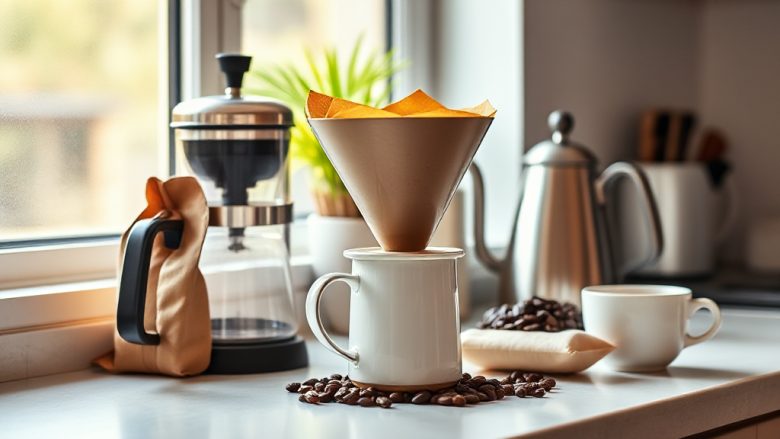
The useful question isn’t which brewer makes the best coffee. It’s which brewer costs the least per good cup over a year. That’s a different calculation, and it trips up most people who start out trying to save money on coffee. A cheap dripper with expensive paper filters can cost more across twelve months than a slightly pricier press that needs nothing but hot water and a spoon. Coffee brewing on a tight budget means counting the consumables, not just the hardware on the shelf. I’ve owned the plastic cones, the secondhand presses, the stovetop pot that scalded my hand, and the supermarket ground coffee that tasted like burnt cardboard. Some of that gear was worth every penny. Some of it was a waste of money I never got back.
Here’s the honest breakdown, judged on two numbers: what you pay up front and what each cup costs after that.
How the Cheap Methods Actually Compare
Picture a table with four columns: method, equipment outlay, ongoing cost per cup, and taste ceiling. If I wrote that table out, the rows would read like this.
A plastic pour-over cone costs somewhere between a few pounds and the price of a sandwich, depending on whether you buy the branded version or the generic one. The cone itself lasts years. The filters don’t. You buy them forever, and that’s the catch nobody mentions when they hand you the cheap plastic thing at the till.
A French press costs a little more up front than a cone, usually. It needs no filters at all. Zero ongoing cost beyond the coffee and the electricity to boil water. The glass can break if you’re clumsy, but a replacement beaker is cheap and the metal parts outlive you.
A moka pot sits in the middle on price. It uses no paper, no plastic, and no electricity beyond the hob. It’s a lump of aluminium or steel that will probably outlast your kitchen. The catch is technique: get it wrong and you drink something bitter enough to strip paint.
Instant coffee is the cheapest of all on paper. It’s also the method most likely to make you quit drinking coffee, which has its own hidden savings. I’m not going to pretend it competes on taste, because it doesn’t.
Now the part that matters. Over a year, assuming one or two cups a day, the filter cost of a pour-over setup quietly adds up to more than the price of the cone itself, often several times over. The press and the moka pot don’t have that problem. Their ongoing cost is essentially the coffee, and that’s it.
Pour-Over Cones: Cheap to Start, Costly to Keep
The pour-over cone is the classic entry point, and for good reason. It’s cheap, it’s small, it’s easy to clean, and it makes a genuinely decent cup if you’re willing to pay attention for three minutes. The ritual is pleasant. The results can be excellent.
The problem is the paper. Every single cup eats a filter. Buy them in bulk and the per-filter cost drops to something trivial, but it never reaches zero. Over a year of daily brewing you’re buying boxes of the things, and if you forget to restock you’re standing in the kitchen at seven in the morning with a cone full of wet grounds and no way to brew. That’s the real tax: not just money, but dependence on a consumable.
Taste-wise, a cone gives you clarity. It’s the method that shows off a good bean best. If you’re buying cheap supermarket grounds, though, that clarity works against you. Every flaw in the coffee comes through. A cheap cone plus cheap beans is a combination that flatters neither.
Verdict: fine if you already own it, fine if you drink one cup a day, less fine if you’re brewing for two people every morning and buying filters by the month.
French Press: The Cheapest Good Cup I’ve Found
The press is the method I keep coming back to when money is tight, and it’s not close. You buy it once. You never buy anything for it again. The grounds go in, the water goes in, you wait four minutes, you push the plunger, you drink. The cleanup is a rinse and a wipe. There’s no filter to run out of, no pod to order, no machine to descale.
The taste is fuller and heavier than a cone. Some of the fine grounds slip through the mesh, so you get a slightly muddy cup. If that bothers you, let it settle for a minute before pouring. I’ve never found it worth losing sleep over, and I’d rather have a full-bodied cup than a clear thin one made with cheap beans.
The one genuine cost is breakage. Glass beakers crack. If you have a household with children or a habit of knocking things off counters, factor in the occasional replacement. Even then, the maths holds. A press plus a bag of decent grounds beats a cone plus filters plus the same grounds over any twelve-month stretch.
There’s a smaller point too. A press is forgiving. You can use slightly stale beans, you can eyeball the ratios, you can walk away for six minutes instead of four, and you still get something drinkable. Cheap gear that demands precision is a trap for tired people. Cheap gear that tolerates sloppiness is a gift.
Moka Pot and Instant: Where the Savings Get Complicated
The moka pot is the romantic option. It looks good on the hob, it makes a strong, syrupy coffee that stands up to milk, and it costs nothing to run beyond the gas. On pure economics it’s right up there with the press, and it arguably makes a more intense cup that goes further if you’re adding milk.
The complication is skill. A moka pot brewed carelessly tastes burnt and harsh. You need to preheat the water, fill the basket level without tamping, and pull it off the heat the moment it starts to sputter. None of that is hard, but it’s more fiddly than a press, and fiddly methods get abandoned. An abandoned moka pot on a shelf is the most expensive brewer of all, because you paid for it and got nothing.
Instant coffee is the true budget floor. A jar costs very little per cup, it never goes off in any meaningful way, and it requires nothing but a kettle. If the goal were purely to spend the least money on a hot brown drink, instant would win and we could all go home. But the goal is the least money per good cup, and instant loses that race badly. It’s cheap in a way that makes you want to buy coffee out instead, which is the opposite of saving money.
There’s one honest use for instant: as a backup. Keeping a small jar in the cupboard means you’re never forced to buy an overpriced cup on the way to work because you ran out of beans. That’s a genuine saving, just not a brewing method you’d choose for pleasure.
The Single Pick, and a Word on Cheap Beans
If I had to choose one method for someone brewing on a tight budget, it’s the French press. It has the lowest total cost of ownership of any method that still makes coffee worth drinking. One purchase, no consumables, forgiving technique, and a cup that holds up even when the beans aren’t great. Everything else either costs you money every week or demands attention you won’t always have.
The pour-over cone is the better brewer if you’re buying good beans and drinking one cup a day. The moka pot is the better brewer if you want something strong and you enjoy the ritual. But neither beats the press on the only metric that matters here, which is pounds spent per decent cup across a year.
One last thing, because it’s where most budget coffee actually goes wrong. The brewer is a one-time cost. The beans are forever, and they’re where the real money leaks out. Buying pre-ground supermarket coffee in small bags is the most expensive habit in home brewing, because you pay a premium for small quantities and the coffee is stale before you finish it. Buying whole beans in larger bags and grinding them yourself, even with a cheap hand grinder, drops the cost per cup sharply and improves the taste at the same time. A modest grinder pays for itself within a couple of months against the price difference between small bags and large ones.
So the cheapest reliable setup isn’t the fanciest one. It’s a press you already own, a hand grinder that costs less than a month of takeaway coffee, and the biggest bag of whole beans you can store without them going stale. That’s coffee brewing on a tight budget done properly, and it beats the expensive gear more often than the shops would like you to think.